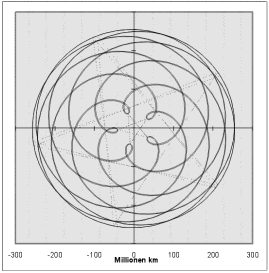
Figure 2.1
It has long been known ‘possibly since the time of the Babylonians’ that the relation of the movements of the planets Venus and Earth is geometrically structured according to the number five. When we continually plot the movement of Venus from a geocentric view we obtain a fivefold loop figure. If we connect the subsequent positions of conjunction of both the planets by lines this leads to a nearly exact pentagram. As shown in Fig. 2.1, one pentagram which forms in an 8-year period is turned only by 2.4 degrees compared to the preceding one.
Figure 2.1 Venus/Earth-loops as seen from Venus over a period of 15.987 years (including 10 conjunctions). The pentagrams show the positions of the conjunctions and oppositions (on the outside). A view from Earth yields the same figure, only turned by 180 degrees.
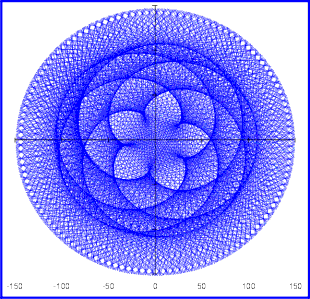
Figure 2.2
In the representation of the linklines or ‘Raumgeraden’, (i.e. the imaginary connecting lines between two planets within a fixed period), a concept developed by the author, it can be seen that the geometrical formative principle repeats itself in the heliocentric view. After about eight years we witness the full blossom of a fivefold starflower shown in Figure 2.2
Figure 2.2 Linklines between Venus and Earth, continually plotted, stepping interval 3 days (1000 times). Scale in millions of km. Sun in the centre of the co-ordinate plane. © Keplerstern Verlag
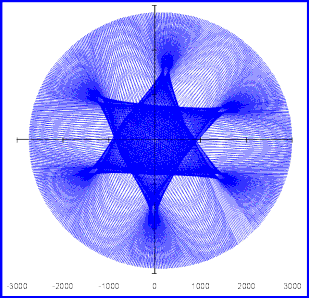
The evenness of these figures results from the very exact 13/8 proportion of the periods of revolution of both planets (and is independent of the chosen 3-day interval). Ratios of small integers of this type are called resonances in celestial mechanics. In the long term they can influence the stability of the orbits of planets or asteroids. This influence can have a reinforcing but also a destabilising effect, depending on the gravitational interaction between the celestial bodies, caused by the build-up of resonance. The graphics of movements shown here, give an overall impression of these influences. Up to the number 12 there is only one more geometrically distinct resonance among the relations of any two planets within our solar system, as shown in Fig. 2.3. (Why the number 12 serves as the upper limit the planets will explain “for themselves” shortly).
Figure 2.3 Linklines between Jupiter and Uranus, continually plotted, stepping interval 60.78 days (1000 times), total space of time 166.4 years. © Keplerstern Verlag
Strangely enough the pentagram, which has been associated with the human being since ancient times, manifests itself in the inner solar system, in the relation of Earth and Venus, the goddess of love. In outer regions, on the other hand, we see the hexagram, a symbol for the permeation of two polar principles, which constitute the order of the material world. To delve more deeply into the symbolic language, which seems to be incorporated in our cosmic home, we now have to consider other planets, i.e. the constellations of three of them at a time. As already mentioned the Venus/Earth pentagram forms, when we plot the positions of their conjunctions continually and draw lines between them (in geocentric as well as in heliocentric view).
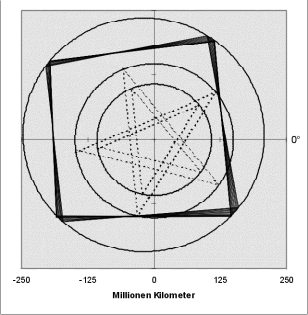
Figure 2.4
If we plot the position of Mars after each complete formation of a pentagram and connect the various points, we obtain an almost fully resonant square. It is just slightly distorted, due to the relatively high eccentricity of the Mars revolution (compare Figure 2.4).
Figure 2.4 Mars in relation to Venus/Earth-pentagrams (150 times); from inside to outside: orbits of Venus, Earth and Mars over a total period of approx. 1195 years. The Venus/Earth pentagram is noted only once in each orbit. © Keplerstern Verlag.
The symbol of the human being is thus placed into a quadrangle; one could also say, man is nailed to the cross of the world or of the god of war. A cross arises if one connects the opposite corners of the square, but it materialises also in other diagrams, or patterns, of planetary movement, but this goes beyond the scope of this summary. Even without this interpretation the geometrical constellation between our home planet and its two cosmic neighbours is so remarkable, that you have to wonder, why it has never been mentioned in any relevant literature on the planetary system. … …
The geometrical relationship of any three planets can also be represented in two other types of graphic, the geocentric (or, more generally speaking, planetocentric) loop diagram on the one hand, and the heliocentric linklines diagram on the other. We obtain these diagrams by continually plotting the position of one planet as seen from a second one, when the first (or the second) is in conjunction with a third. In addition we plot the link lines at the given points in time. The result are general graphical representations of the gravitational interaction between any three planets. Among the great number of all possible constellations involving the nine planets of our solar system all numbers up to twelve emerge exactly once! Furthermore the different figures stand in an internal numerical order, i.e. in a network of relations organized by small integers, with a mysterious overall architecture, which can only be briefly mentioned here. For example, the hexagram of Jupiter and Uranus combined with Mars or Earth or Venus transforms into geometrical forms, that are governed by the number 5 (Mars) and its multiples 10 (Earth) or 20 (Venus).
-
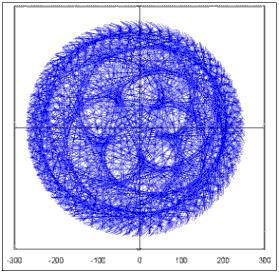
Figure 2.5 Mars-Jupiter linklines at Mars/Uranus conjunctions,
1000 times, starting on 22 Sept. 2001, period 1923.88 years (detail enlargement 3/1).
© Keplerstern Verlag -
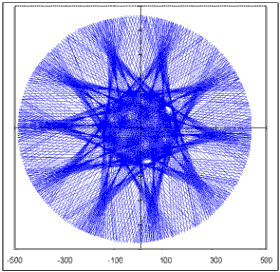
Figure 2.6 Earth-Jupiter linklines at Earth/Uranus conjunctions,
750 times, starting on 11 Aug. 2000, period 759.03 years (detail enlargement 10/6).
© Keplerstern Verlag -
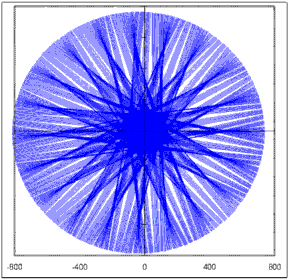
Figure 2.7 Venus-Jupiter linklines at Venus/Uranus conjunctions,
1000 times, starting on 26 March 2000, period 619.72 years.
© Keplerstern Verlag
The observed doubling of numbers – which obviously determines the formation of the figures between the planets involved and which corresponds musically to the octave and double octave – seems somewhat mystical; at least there are no mathematical reasons known to the author. Moreover, in the opposite direction, a sixfold blossom springs from the Venus/Earth pentagram (the starflower), when Pluto is included as the third planet. The most impressive figure, however, emerges in a similar manner from the relation of the three most massive planets Jupiter, Saturn and Neptune. As we have seen, Jupiter, which is by far the biggest planet, had its share in the formation of the hexagram. Now, in co-operation with the two other mentioned members of the outer region, the symbol of polarity reaches perfection, raised, so to speak, into its higher octave.
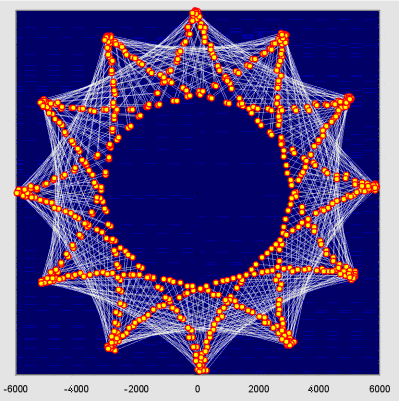
In the outer planetary system, which is the space that borders on the stars with their zodiac, the ancient symbolic number that was associated with the sky and heaven in different cultures appears before our eyes and our mind. In heliocentric view this would also result in a star shape, if less expressive, organized by the number twelve. In the planetocentric graph shown the connecting lines of the constellations produce two hexagons, while the succession of positions arrange themselves ‘as though guided by an invisible hand’ in three quadrangular, star-shaped forms. These figures individually are called astroids. Three astroids are woven into a twelve-pointed star and together with the web formed by the connecting lines a degree of geometrical perfection is achieved, which may touch the human heart almost like music.
Pythagoras never said, argued the German philosopher Friedrich W.J. Schelling, that these movements (of the planets) cause the music, but that they themselves are the music. This indwelling movement needed no external medium through which it might become music, for it was of itself music.